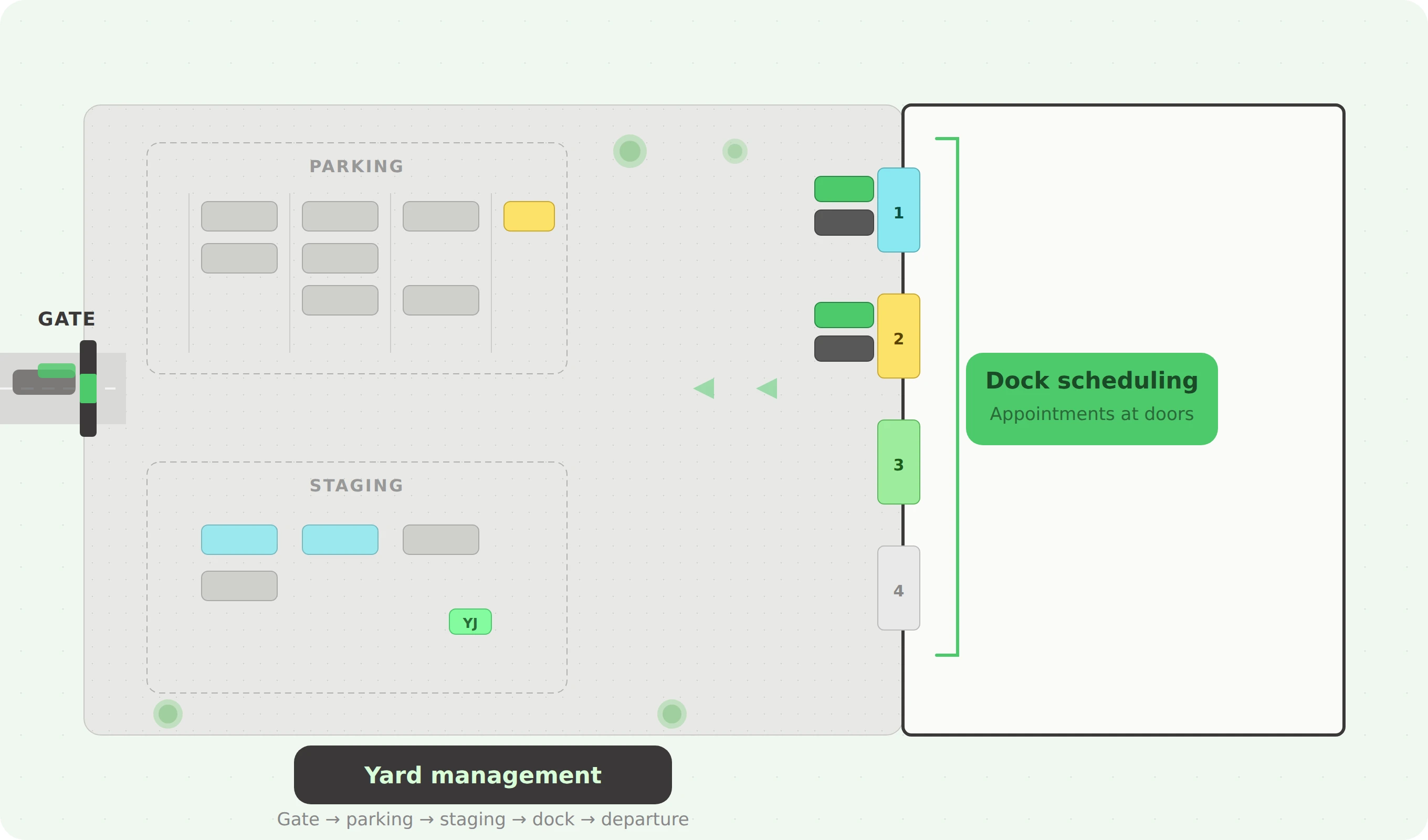
Dock scheduling manages truck appointments at your loading docks. Yard management tracks and controls trailer movements across your entire yard — from the gate to the dock and back out again. They solve different problems, cost very different amounts, and most small-to-mid-size warehouses need dock scheduling long before they ever need a yard management system.
This guide explains exactly what each one does, where they overlap, and how to decide which your warehouse actually needs. We build dock scheduling software — not yard management — so we'll be upfront about where our product fits and where it doesn't.
What is dock scheduling software?
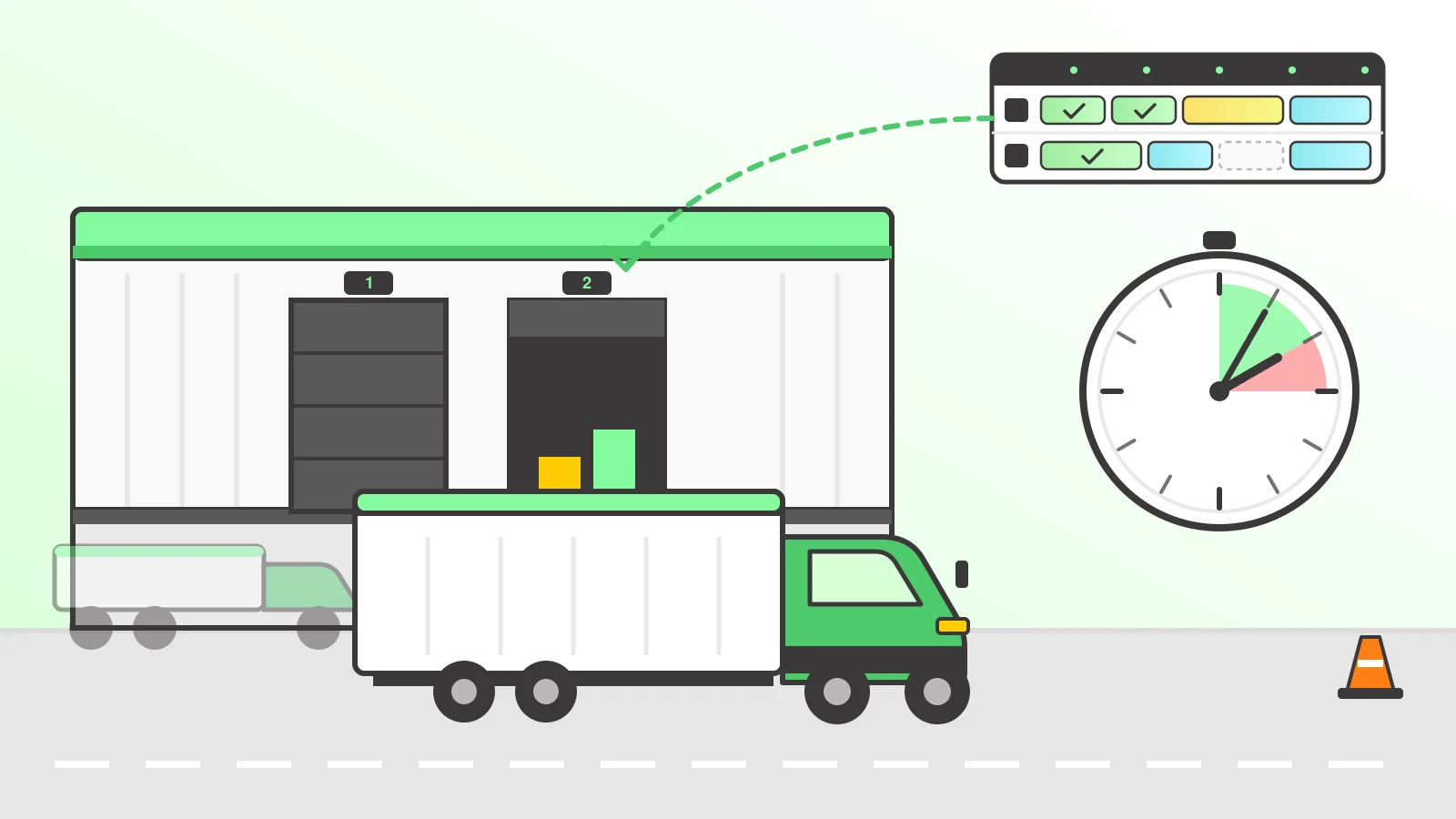
Dock scheduling software replaces the phone calls, emails, and spreadsheets that warehouses use to coordinate truck arrivals at loading docks. It gives warehouse teams a shared calendar showing which trucks are expected at which dock doors, and when. Carriers can book their own time slots through a self-service booking portal, eliminating the back-and-forth that eats up hours every week.
The core functions include:
- Appointment scheduling — a calendar-based interface with drag-and-drop, conflict detection, and color-coded appointment types.
- Dock and time slot configuration — define operating hours for each dock door, set loading durations by type (e.g., 60 minutes for a partial load, 120 minutes for a full truckload), and control how many trucks can be scheduled per dock per hour.
- Carrier self-booking — a branded portal where carriers view available slots and book 24/7, without needing to create an account or call your team.
- Check-in and status tracking — digital check-in when drivers arrive, real-time dock status updates, and timestamp capture for every event in the loading lifecycle.
- Automated notifications — email confirmations, reminders, and change alerts sent to warehouse staff and carriers automatically.
- Reporting — dwell time, on-time performance, dock utilization rates, and carrier scorecards.
Think of dock scheduling as the logistics equivalent of an online restaurant reservation system. Carriers see what's available, book a slot, get a confirmation, and show up at the right time. The warehouse knows exactly who's coming and when.
If you're unsure whether your operation has reached the point where software makes sense, our guide on how to know if you need dock scheduling software walks through the common signs.
What is yard management software?
A yard management system (YMS) monitors, manages, and optimizes the movement of trailers, containers, trucks, and assets within a facility's yard — the outdoor area between the gate and the dock doors. Gartner defines it as software that provides an overview of yard operations and supports the planning, direction, and control of scheduling, movement, parking, inspection, and reassignment of trucks, trailers, and containers.
The core functions include:
- Gate check-in and check-out — automated using kiosks, QR codes, RFID tags, license plate recognition cameras, or mobile apps.
- Real-time trailer tracking — knowing exactly where every trailer is parked, using technologies like RFID, GPS, Bluetooth sensors, or AI-powered cameras.
- Yard driver task management — digital dispatching for yard jockeys (the drivers who move trailers between parking spots and dock doors), with priority sequencing and mobile task lists.
- Yard mapping and visualization — a digital twin of the physical yard showing every trailer position, dock status, and empty spot, often with drag-and-drop move capabilities.
- Detention and demurrage tracking — automatic monitoring of how long trailers sit in the yard, with alerts before penalty thresholds are reached.
- Dock door assignment — rule-based automation that routes trailers to specific doors based on cargo type, temperature requirements, or priority level.
If dock scheduling is an online reservation system, yard management is the air traffic control tower. It doesn't just know when planes are supposed to land — it tracks every aircraft on the ground, directs them to gates, manages ground crews, and monitors the entire airfield in real time.
What's the difference between dock scheduling and yard management?
The simplest way to understand the difference: dock scheduling is about planning (what happens before and at the dock door), while yard management is about execution (what happens across the entire yard, from gate to departure).
Here's a side-by-side comparison:
| Dock Scheduling | Yard Management (YMS) | |
|---|---|---|
| Primary purpose | Schedule and coordinate truck appointments at dock doors | Track and control all trailer and asset movements across the yard |
| Scope | Dock doors and the appointment calendar | Entire yard: gate -> parking -> dock -> departure |
| Timing focus | Pre-arrival planning and at-dock coordination | Real-time operations during and after arrival |
| Visibility | Which dock doors are available and when | Where every trailer, driver, and asset is right now |
| Trailer tracking | No (or minimal — arrival/departure only) | Core capability with real-time location |
| Gate management | Limited or none | Full gate check-in/check-out automation |
| Yard driver dispatching | No | Yes — task assignment, routing, and tracking |
| Yard mapping | No | Yes — digital twin of the physical yard |
| Dwell time monitoring | Basic (time at dock) | Comprehensive (total time in yard with penalty alerts) |
| Carrier self-service | Yes — core feature for many platforms | Sometimes included, but not the focus |
| Typical cost | $99–$500/month | $5,000+/year (enterprise significantly more) |
| Implementation time | Minutes to days | Days to months |
| Best for | Any warehouse with loading docks | Facilities with large yards and many trailers on-site |
The key takeaway from this table: dock scheduling and yard management operate at different scales and different price points. Dock scheduling is a targeted solution for a specific, high-impact problem (appointment chaos at the dock). Yard management is a broader operational platform for a more complex problem (visibility and control across an entire yard).
Do you need dock scheduling, yard management, or both?
This is the question that really matters — and the one most articles on this topic dodge. Most software vendors sell both capabilities, so their answer is always "you need both." We only sell dock scheduling, so we can be honest about where our product fits and where it doesn't.
You probably only need dock scheduling if:
Your primary pain is appointment chaos. Trucks show up unannounced, multiple carriers arrive at the same time, your team spends hours on the phone coordinating arrivals, and drivers wait in line because there's no structured schedule. A dock scheduling system solves this directly.
You primarily do live loads and unloads. In a live-load operation, the truck stays at the dock while goods are loaded or unloaded, then leaves. There are no trailers parked in the yard for extended periods, so there's nothing to "manage" in the yard. Dock scheduling handles the entire workflow.
Your yard is small or simple. If your facility has fewer than 50 trailers on-site at any given time, and drivers can see available parking spots without guidance, a full YMS adds complexity you don't need.
You have 2–25 dock doors. This is the sweet spot for pure dock scheduling. The coordination challenge is real (scheduling conflicts, carrier communication, utilization tracking), but it doesn't require yard-wide operational control.
You're still using spreadsheets, whiteboards, or phone calls. If you haven't digitized your scheduling process at all, dock scheduling is the logical first step. It delivers the fastest ROI — often within the first month. You can calculate your potential savings here.
You probably need yard management if:
You run a drop-trailer operation. When carriers drop trailers in your yard and pick them up later, you need to know where each trailer is, how long it's been sitting there, and when it needs to move. This is the core YMS use case.
You have 50+ trailers on-site at any time. At this scale, manually tracking trailer locations becomes unreliable. Yard jockeys waste time searching for trailers, detention fees accumulate on forgotten units, and dock doors sit empty because no one can find the right trailer to move in.
You have a large physical yard. Multiple acres of parking, staging areas spread across different zones, and trailers that need to be shuffled between locations throughout the day. A digital yard map becomes essential.
You employ yard jockeys or spotters. If you have dedicated yard drivers moving trailers between parking spots and dock doors, YMS task management dramatically improves their efficiency by eliminating radio calls and clipboard-based dispatching.
Detention and demurrage fees are a major cost center. If you're paying significant penalties because trailers sit in your yard too long, a YMS with automated dwell-time alerts can reduce those costs substantially. Warehouses that implement yard management technology typically see meaningful reductions in detention charges and faster trailer check-in/check-out times.
You need both when:
You're a high-volume distribution center. Handling hundreds of appointments per day across dozens of dock doors, with a mix of live loads and drop trailers, requires both appointment precision and yard-wide visibility.
You manage multiple facilities. Multi-site operations benefit from centralized scheduling (dock) plus real-time visibility across all yards (YMS).
You're in a compliance-heavy industry. Food and beverage, pharmaceutical, and cold chain operations often need both scheduled dock times (for food safety coordination) and yard-level tracking (for chain of custody documentation).
For most small-to-mid-size warehouses — manufacturers, wholesalers and distributors, and 3PL providers — dock scheduling alone delivers the biggest impact for the least investment. It's the 80/20 solution: you solve 80% of your scheduling headaches for a fraction of the cost.
How do dock scheduling and yard management work together?
When both systems are in place, the data flows in a logical sequence that covers the entire truck visit:
Before arrival — The dock scheduling system manages the appointment. A carrier books a time slot through the self-service portal. The warehouse receives a confirmation with carrier details, load type, and expected arrival time.
At the gate — The YMS takes over. The driver checks in (via kiosk, mobile app, or guard), the system verifies they have a valid appointment, and assigns them a yard parking spot or directs them straight to a dock.
In the yard — The YMS tracks the trailer's location. If it's a drop trailer, the system records where it's parked. When a dock door becomes available, the YMS dispatches a yard jockey to move the trailer into position.
At the dock — Both systems share data. The dock scheduling system updates the appointment status (arrived -> in progress -> done), while the YMS tracks the time spent at the dock.
After departure — The YMS logs the check-out, captures total dwell time, and updates the yard map. The dock scheduling system records completion timestamps that flow back into reporting and, if integrated, into the TMS or WMS.
The integration between these systems typically happens through APIs. A well-designed dock scheduling tool exposes an API for integrations that lets it connect to yard management platforms, warehouse management systems, and transport management systems, creating a continuous data flow across the entire logistics operation. For more on how this works with transport management, see our TMS integration guide.
The important point: you don't need to implement both at the same time. Most operations start with dock scheduling (faster to deploy, lower cost, immediate ROI), then add yard management later if and when yard complexity demands it.
How much does each type of software cost?
Cost is one of the clearest differentiators between these two categories, and it often determines the practical starting point for most warehouses.
Dock scheduling software ranges from €99/month for self-serve platforms to $7,000+/year for enterprise solutions sold through consultative sales processes. At the lower end, you get appointment management, carrier self-booking, notifications, and basic reporting. At the higher end, you get multi-site management, advanced analytics, and dedicated support. For a detailed breakdown, see our comparison of the best dock scheduling software.
Yard management systems typically start at $5,000+ per year and scale significantly higher depending on yard size, number of gates, hardware requirements (RFID readers, cameras, kiosks), and integration complexity. Even mid-market YMS options generally run several thousand dollars per year, plus implementation fees.
The ROI math differs accordingly. A dock scheduling tool at €99/month that eliminates 5 hours of weekly scheduling labor and reduces one detention fee incident per month pays for itself almost immediately. A YMS at tens of thousands per year needs to demonstrate savings in the hundreds of thousands to justify the investment — which it can, for the right operation, but the bar is much higher.
Where does LoadingCalendar fit?
LoadingCalendar is a dock scheduling platform. We don't include yard management, trailer tracking, gate automation, or yard jockey dispatching — and that's a deliberate choice.
We built LoadingCalendar for small-to-mid-size warehouses, manufacturers, and distribution centers that need to get their dock scheduling under control without buying an enterprise platform. The kind of operation where one or two people manage receiving and shipping, carriers still call or email to book appointments, and the scheduling "system" is a whiteboard or a shared spreadsheet.
If that sounds familiar, here's what we offer:
- Flat pricing at €99/month — unlimited docks, unlimited users, unlimited carriers. No per-user fees, no per-dock surcharges.
- Self-service setup — most customers are up and running in under an hour. Create your warehouse, add docks, set operating hours, and share your booking link with carriers.
- Carrier booking portal — a branded portal where carriers book their own appointments 24/7. No account creation required. Carriers enter their email, get a magic link, and book.
- Full loading lifecycle tracking — every appointment moves through a clear status flow (new -> arrived -> in progress -> done), with timestamps and audit logs.
- 25+ languages — the entire interface and booking portal support over 25 languages, making it practical for operations with international carriers.
- REST API — connect LoadingCalendar to your WMS, TMS, ERP, or yes, your yard management system.
- 14-day free trial — no credit card required. Start your free trial here.
If your warehouse has outgrown manual methods but doesn't need a six-figure yard management platform, dock scheduling is the right starting point. And if you eventually grow into needing yard management, LoadingCalendar's API means your dock scheduling data can flow into whatever YMS you add later.
Not sure if you've hit that tipping point yet? Check out our post on the 5 signs your warehouse has outgrown whiteboard scheduling.
Frequently asked questions
Is yard management part of warehouse management?
Not exactly. Warehouse management systems (WMS) handle operations inside the building — inventory, picking, packing, and shipping. Yard management handles operations outside the building — trailer movements, parking, and gate activity. Some enterprise WMS platforms include a basic YMS module, but dedicated YMS tools typically offer far more depth in yard-specific functions like trailer tracking, yard mapping, and jockey dispatching.
Can dock scheduling replace yard management?
For many operations, yes — at least in practice. If your trucks arrive, dock at an available door, load or unload, and leave (live-load operations), then dock scheduling covers the entire workflow. You don't need to track trailers in the yard because they're either at a dock or gone. Yard management becomes necessary when you have a significant number of trailers parked in the yard for extended periods.
What is the difference between a YMS and a TMS?
A Transport Management System (TMS) manages shipments while they're on the road — route planning, carrier selection, freight rate management, and shipment tracking. A Yard Management System (YMS) manages vehicles and trailers once they arrive at a facility. The two systems complement each other: TMS data (like estimated arrival times) feeds into the YMS so the yard can prepare for incoming trailers.
How does dock scheduling reduce detention fees?
Detention fees occur when trucks wait too long to be loaded or unloaded — typically $25–$100 per hour after a grace period. Dock scheduling reduces detention by spreading arrivals across available time slots, eliminating the bunching that causes long wait times. When carriers book specific appointments and the warehouse is prepared for their arrival, trucks spend less time idling. According to ATRI's research on truck driver detention, drivers experienced detention at roughly 39% of stops — a staggering share of all deliveries and pickups. For the facility-side playbook — free-time terms, slot lengths, timestamps — see how to reduce detention fees at your warehouse.
Do small warehouses need dock scheduling software?
If you're managing even 5–10 truck arrivals per day across a handful of dock doors, dock scheduling software can save meaningful time and prevent conflicts. The threshold isn't really about warehouse size — it's about whether scheduling coordination is consuming your team's time or causing operational friction. If you're spending more than 30 minutes a day on scheduling calls and emails, software will pay for itself quickly.
What technologies are used in yard management?
Modern YMS platforms use a combination of RFID tags and readers, GPS tracking, Bluetooth Low Energy (BLE) sensors, AI-powered cameras with license plate recognition, mobile apps for yard drivers, and IoT sensors for trailer status monitoring (loaded, empty, sealed). The specific technology mix depends on yard size, budget, and required accuracy.
LoadingCalendar is dock scheduling software for warehouses, built by the team behind Cargoson TMS. We help small-to-mid-size warehouses eliminate scheduling chaos with a simple, affordable platform. Start your 14-day free trial — no credit card required.
You might also like
The four dock scheduling KPIs that matter: dock utilization rate, truck dwell time, on-time arrival rate and no-show rate. Formulas, a worked example and honest benchmarks.
OTIF (On Time In Full) is the share of orders delivered complete and within the agreed window. Formula, worked example, benchmarks and how to measure it.
How to reduce detention fees: put every truck on an appointment, match slot lengths to real loading times, and log arrival, dock-in and departure automatically.
Ready for simpler warehouse scheduling?
Join warehouse teams across the world that replaced spreadsheets and phone calls with simple dock appointment scheduling software.
Start My Free Trial 14-day free trial · No credit card required · Cancel anytime