
Dock Scheduling Software ROI Calculator
See how much your warehouse can save by replacing manual scheduling with automated dock management.
Your warehouse details
Savings breakdown
If you're still scheduling dock appointments by phone, email, and spreadsheets, you're spending far more than you realize. The costs aren't always obvious — they're buried in coordinator overtime, carrier detention invoices, idle dock doors, and the daily chaos of trucks arriving without appointments.
We built this calculator to help warehouse managers see exactly where the money goes and how much of it automated dock scheduling can recover. The cost data draws on published industry research, the reduction assumptions are clearly documented, and the methodology is fully transparent.
The four hidden costs of manual dock scheduling
Most warehouse managers know manual scheduling is inefficient. Few realize how expensive the inefficiency actually is. The costs fall into four categories, each of which compounds the others.
1. Scheduling labor: 15–25 hours per week of coordinator time
Manual dock scheduling is labor-intensive in a way that's hard to appreciate until you measure it. Every incoming truck requires coordination — a phone call or email to confirm arrival time, manual entry into a spreadsheet or whiteboard, follow-up when plans change, and a second round of calls when they inevitably do.
A typical mid-size facility processes 20–50 trucks per day. At an average of 5 minutes per scheduling interaction (and most take longer when changes are involved), a facility handling 30 trucks daily spends roughly 2.5 hours per day on scheduling alone. Add in the back-and-forth of rescheduling, no-show follow-ups, and end-of-day reconciliation, and the total climbs to 15–25 hours per week across all coordinators involved.
At a fully loaded cost of around €31 per hour for a logistics coordinator (base salary plus benefits and overhead), that adds up to €24 000–€40 000 per year in scheduling labor at a single facility. You can adjust the hourly rate in the calculator to match your actual costs.
With automated self-service booking — where carriers select their own time slots through a branded portal — facilities routinely see the majority of appointments scheduled without any staff involvement. When the scheduling burden shifts to carriers (who prefer it, because it eliminates their phone tag too), coordinators recover hours they can redirect to higher-value work.
2. Detention fees: the $15 billion industry problem hitting your invoices
The American Transportation Research Institute (ATRI) published a comprehensive detention study in September 2024, surveying 587 truck drivers and 245 motor carriers. The findings are striking: 39.3% of all pickup and delivery stops involve detention, with drivers losing between 117 and 209 hours per year to waiting — time they can't drive, earn, or use productively. The study estimated the total industry cost of detention at $15.1 billion in 2023 alone, combining $11.5 billion in lost driver productivity with $3.6 billion in direct expenses.
Detention charges typically range from €25 to €100 per hour depending on the carrier, lane, and contract terms. For a mid-size facility with 30 trucks per day, even a modest detention rate produces monthly invoices in the thousands. Carriers are becoming more aggressive about enforcing detention charges, and the trend is accelerating as driver shortages make wait time increasingly costly. The OOIDA Foundation's 2023 survey of independent truck drivers found that only 49% always attempt to receive compensation for detention time, while 12% never even try — meaning a significant share of detention costs are absorbed silently across the supply chain, driving up carrier rates for everyone. The facility-side fixes — appointments, realistic slot lengths, logged timestamps — are covered step by step in how to reduce detention fees at your warehouse.
3. Overtime and congestion: the afternoon pile-up effect
Every warehouse manager knows the pattern: mornings start slow, then a wave of uncoordinated arrivals hits mid-afternoon, creating dock congestion, yard backups, and forced overtime to clear the queue before end of shift. Without scheduled time slots, truck arrival patterns follow carrier convenience rather than warehouse capacity.
This pattern forces overtime at 1.5x hourly rates while leaving dock doors underutilized during off-peak hours. Without time slots, arrival patterns cluster around mid-day and late afternoon — not because those times are optimal for the warehouse, but because they're convenient for carriers running morning pickups before afternoon deliveries. The result: docks are overwhelmed for three hours and idle for five. Structured appointment scheduling distributes arrivals evenly across operating hours, converting expensive overtime spikes into predictable, manageable workloads.
4. Indirect costs: errors, missed deliveries, and strained carrier relationships
Manual scheduling produces errors — double-bookings, missed appointments, incorrect dock assignments, and communication breakdowns between shifts. These errors cascade into missed delivery windows, OTIF (On-Time In-Full) penalties from retail customers, and strained relationships with carriers who learn to avoid facilities known for long waits and poor organization.
These costs are harder to quantify but no less real. A single missed delivery window to a major retail customer can trigger penalties of €500–€5 000 or more, depending on the contract. According to the ATRI study, detention is a leading cause of driver turnover — and the facilities responsible for it suffer from reduced carrier willingness to accept loads, higher freight rates, and diminished service priority during tight capacity markets.
Dock Scheduling Software ROI Calculator
See how much your warehouse can save by replacing manual scheduling with automated dock management.
Your warehouse details
Savings breakdown
How the calculator works
Our calculator uses four inputs that any warehouse manager can estimate in under a minute. Here's what each one measures and where the savings come from.
Trucks per day drives the overtime calculation. Higher volume facilities have more to gain from structured scheduling because the inefficiency cost per truck compounds across every arrival.
Hours per week on scheduling captures your current labor investment in manual coordination. This includes all phone calls, emails, spreadsheet updates, carrier confirmations, rescheduling, and no-show follow-ups. If you're not sure, track it for one week — most managers are surprised at how high the number actually is.
Coordinator hourly rate should reflect the fully loaded cost — not just base salary, but also benefits, payroll taxes, and overhead. The calculator defaults to €31/hour, which is a reasonable average for a logistics coordinator. Adjust it to match your facility's actual labor costs.
Monthly detention fees may appear on carrier invoices as detention charges, waiting time fees, or accessorial charges.
The reduction assumptions
The calculator applies these reduction percentages to your inputs:
70% scheduling labor reduction — When carriers book their own appointments through a self-service portal, the majority of scheduling coordination (phone calls, emails, spreadsheet updates, confirmations) is eliminated. We use 70% rather than a higher figure to account for the learning curve during carrier adoption and the reality that exception handling, rescheduling, and internal coordination will always require some human involvement.
50% detention fee reduction — Pre-confirmed time slots matched to available dock doors eliminate a primary driver of detention: trucks arriving without a plan. The ATRI 2024 study notes that detention may be caused by "scheduling issues on the customer's part, inadequate parking and dock space, inadequate staffing at customer facilities, or upstream delays in production." Automated scheduling directly addresses the first of these causes. The 50% figure is a midpoint estimate — conservative for facilities with severe congestion, aggressive for those with mild issues.
25% overtime reduction — Without scheduled time slots, truck arrivals cluster around mid-day and late afternoon, creating congestion spikes that force unplanned overtime. Appointment-based scheduling distributes arrivals evenly across operating hours, flattening the arrival curve. We use 25% as a conservative estimate — facilities with severe afternoon pile-ups will likely see larger reductions, while those with already-smooth arrival patterns will see less.
Why the ROI numbers look so high
If you ran the calculator with default inputs, you probably saw an ROI figure above 3,000% and a payback period measured in days, not months. These numbers aren't inflated — they reflect the simple math of a €99/month tool eliminating tens of thousands in annual waste.
The reason ROI is so dramatic for dock scheduling software is that the cost of the solution (€1 188/year for LoadingCalendar) is tiny relative to the cost of the problem. Manual scheduling labor alone exceeds €20 000/year at most mid-size facilities. Detention fees add another €10 000–€50 000+. The software cost is a rounding error by comparison.
This is also why even significantly more expensive enterprise dock scheduling solutions still show positive ROI — the problem is expensive enough to justify almost any solution. At €99/month, LoadingCalendar offers the same core functionality at a fraction of the price, making the ROI calculation even more compelling for mid-size operations.
What happens after you switch to LoadingCalendar
The transition from manual to automated dock scheduling follows a predictable pattern. In the first week, you configure your docks, set operating hours, and define time slot intervals. You share your branded booking portal link with carriers. Within two to four weeks, the majority of recurring carriers adopt self-scheduling — most prefer it because it eliminates their phone tag burden too.
By month two, your scheduling coordinators are spending their recovered hours on higher-value work: optimizing dock assignments, improving carrier relationships, or handling exceptions rather than routine bookings. Detention charges drop as carriers arrive at confirmed times. The afternoon congestion pile-up flattens as arrivals distribute across available slots.
The compounding effect is significant: as more carriers use self-scheduling, the remaining manual scheduling burden shrinks further, and the system's calendar view gives you visibility you never had with spreadsheets — which docks are busy, which are available, and where bottlenecks are forming.

Chief Operating Officer at Cleveron



Try it with your own numbers
The calculator above uses industry-average defaults, but your facility is unique. Adjust the sliders to match your actual operation — your daily truck volume, how many hours your team currently spends on scheduling, and your detention costs. If you're not sure about detention costs, check your last quarter of carrier invoices for detention line items.
If the numbers make sense — and for most mid-size companies, they do — LoadingCalendar offers a 14-day free trial with no credit card required. You can set up your first dock, configure time slots, and send a booking link to a carrier in under 5 minutes. Most customers see their first self-scheduled carrier booking within the first week.
Data sources
ATRI (2024): "Costs and Consequences of Truck Driver Detention: A Comprehensive Analysis." American Transportation Research Institute, September 2024. Survey of 587 drivers and 245 carriers. Key findings: $15.1B total industry cost, 39.3% of stops involve detention, drivers detained 117–209 hours/year depending on sector.
OOIDA Foundation (2023): "2023 Detention Time Survey." Annual survey of independent truck drivers (253 respondents). Finding: only 49% always attempt to receive detention compensation; 12% never attempt at all.
Frequently asked questions
You might also like

OTIF (On Time In Full) is the share of orders delivered complete and within the agreed window. Formula, worked example, benchmarks and how to measure it.
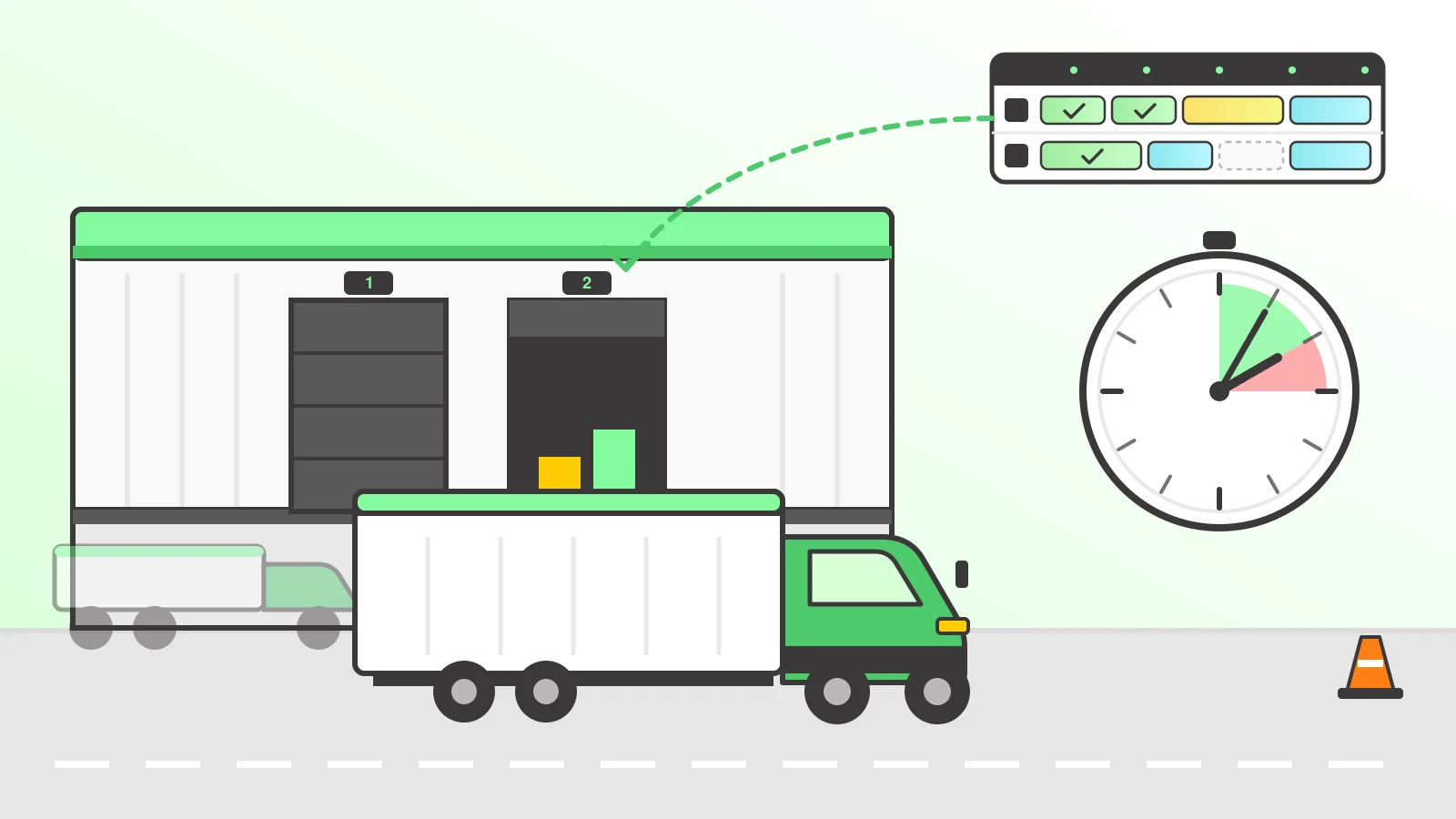
How to reduce detention fees: put every truck on an appointment, match slot lengths to real loading times, and log arrival, dock-in and departure automatically.
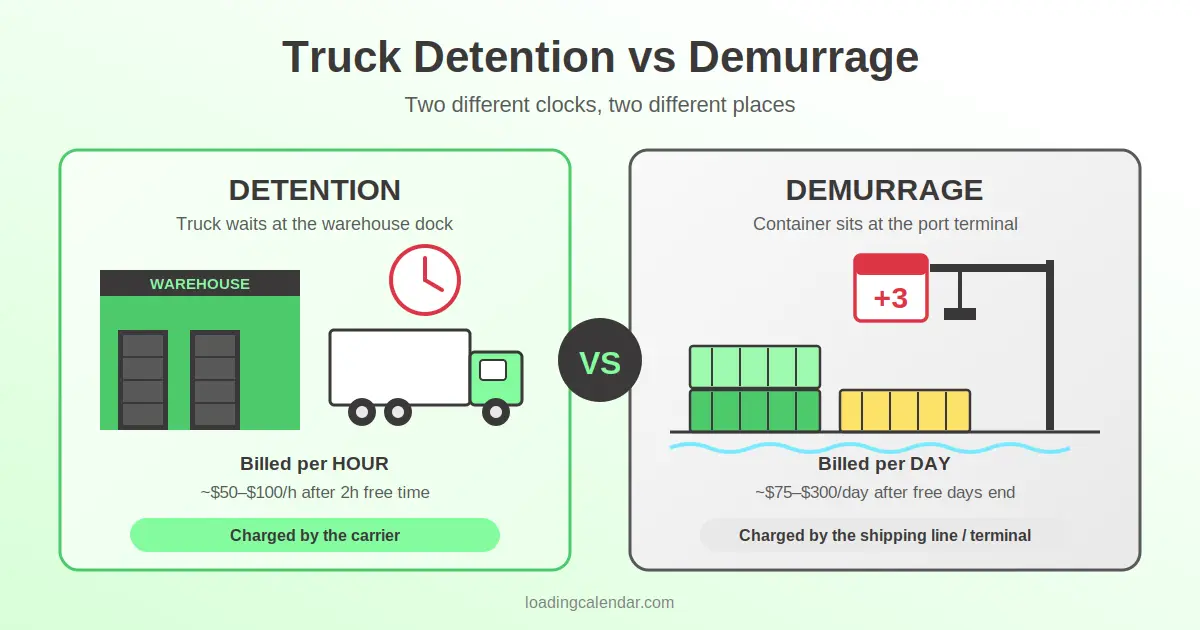
Truck detention is the fee carriers charge when drivers wait past free time — typically $50–$100/hour after 2 hours. Demurrage is a daily port charge. Here's the difference, who pays, and how to avoid both.
Ready for simpler warehouse scheduling?
Join warehouse teams across the world that replaced spreadsheets and phone calls with simple dock appointment scheduling software.
Start My Free Trial 14-day free trial · No credit card required · Cancel anytime