
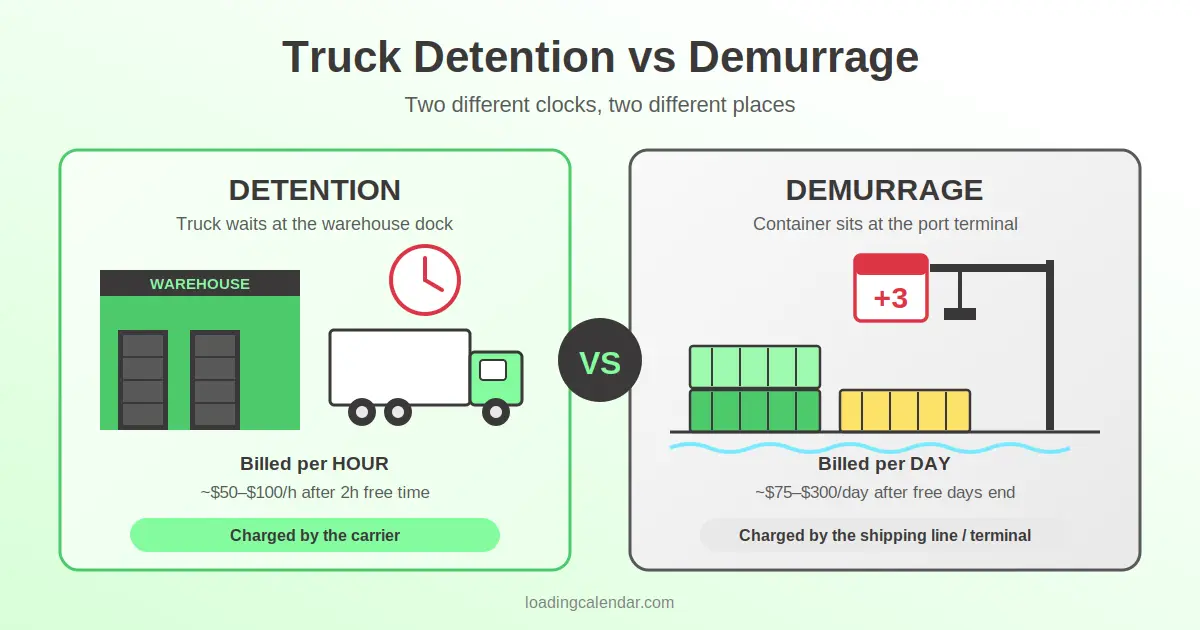
Truck detention is the fee a carrier charges when their driver is held at a warehouse, plant, or distribution center beyond the agreed free time — usually two hours — to load or unload. It's billed by the hour, typically $50–$100 per hour. Demurrage is a different charge entirely: a daily fee a shipping line or terminal applies when a loaded container sits at a port, rail yard, or terminal past its allotted free days.
The short version: detention happens at your dock and is billed per hour; demurrage happens at the terminal and is billed per day. People mix them up constantly — partly because "detention" also has a second meaning in ocean shipping — and the confusion costs real money when the wrong team tries to fix the wrong problem. This guide separates the terms, shows what each one costs, who pays, and what a warehouse can actually do to stop the invoices.
We build dock scheduling software, so we see the warehouse side of detention every day. Most articles on this topic are written for importers or truck drivers; this one is written for the facility that causes the waiting — and pays for it.
What is truck detention?
Truck detention (also called driver detention or detention time) is the time a truck driver spends waiting at a shipper's or receiver's facility beyond the standard free window for loading or unloading. The industry norm is a two-hour grace period; after that, the carrier bills the responsible party an hourly detention fee.
Here's how a typical detention charge plays out:
- A truck arrives at your dock at 09:00 for a live unload.
- The free time clock starts — two hours in most carrier contracts.
- Your team gets to the truck at 12:30 because two other trucks showed up at the same time.
- The truck leaves at 13:15. That's 2 hours and 15 minutes past free time.
- At $75/hour, a detention invoice for roughly $170 lands with the freight bill.
Multiply that by a handful of trucks a week and detention quietly becomes one of the larger avoidable line items in a warehouse's freight spend.
Detention isn't a penalty invented to annoy warehouses. A truck sitting at a dock is a truck not earning revenue, and a driver burning limited hours-of-service drive time while parked. The fee compensates the carrier for that lost capacity — and the data shows the problem is enormous. The American Transportation Research Institute's 2024 detention study found that drivers were detained at 39.3% of all stops in 2023, and that detention cost the US trucking industry $15.1 billion that year: $11.5 billion in lost productivity plus $3.6 billion in direct expenses.
How much do truck detention fees cost?
Truck detention typically costs $50–$100 per hour after a two-hour free window, based on 2025–2026 freight industry rate reporting. LTL shipments tend to sit at the lower end, full truckload higher, and specialized equipment (reefers, tankers, flatbeds with tarping) can run up to about $125 per hour.
| Item | Typical figure | Notes |
|---|---|---|
| Free time (grace period) | 2 hours | Standard in most US carrier contracts; some contracts negotiate 1 hour |
| Detention rate — dry van truckload | $50–$100/hour | Most common range in 2025–2026 rate reporting |
| Detention rate — specialized equipment | Up to ~$125/hour | Reefer, tanker, flatbed |
| Billing increments | 15–60 minutes | Set by the carrier contract or rate confirmation |
| Share of stops with detention (2023) | 39.3% | ATRI, 2024 detention study |
| Hours lost to detention annually | ~135 million | ATRI, 2024 detention study |
| Industry-wide cost (2023) | $15.1 billion | ATRI, 2024 detention study |
Two facts from that same ATRI study should interest anyone on the paying side. First, 94.5% of carriers say they charge detention fees — but fewer than half of those invoices actually get paid. Detention is a constant billing dispute, which wastes hours on both sides even when no money changes hands.
Second, the cost isn't only financial: a 2018 US DOT Office of Inspector General audit estimated that detention cuts driver income by roughly $1.1–1.3 billion per year and found that a 15-minute increase in average dwell time raises a truck's expected crash rate by 6.2%. Facilities with chronic detention also find carriers quietly pricing them higher or declining their loads — the "difficult facility" surcharge never appears as a line item, but it's real.
What is demurrage?
Demurrage is a daily fee charged when a loaded container stays at a port terminal, rail yard, or container depot beyond its allotted free time. The clock starts when the container is discharged from the vessel (or made available for pickup) and stops when the container leaves the terminal gate.
The mechanics differ from truck detention in every important way:
- Where: inside the terminal gate, not at your warehouse.
- Unit: billed per container per day, not per hour.
- Who bills: the shipping line or terminal operator, not the trucking carrier.
- Free time: typically 2–7 free days at most ports, per Freightos (2024) — and shipping lines have been shrinking those windows for years.
- Rates: commonly around $75–$300 per container per day, per Freightos (2024), and many tariffs escalate the daily rate the longer the container sits. Container xChange's benchmark reports have repeatedly found North American ports — New York, Oakland, Los Angeles — to be the world's most expensive for these charges.
A concrete example: your container is discharged in Rotterdam on Monday with four free days. Customs paperwork stalls, your dray carrier can't get a terminal appointment, and the box isn't picked up until the following Wednesday. That's five chargeable days. At $150/day, a $750 demurrage invoice — before the container has even reached your warehouse.
Demurrage exists for the same reason detention does: space at a terminal is scarce, and a container occupying a stack for two weeks is congestion someone has to pay for.
What is the difference between detention and demurrage?
Detention is an hourly charge for holding a carrier's truck and driver at a facility past free time; demurrage is a daily charge for a container occupying terminal space past its free days. Same underlying logic — you're tying up someone else's asset — applied to different assets in different places.
| Truck detention | Demurrage | |
|---|---|---|
| What's being held | The carrier's truck, trailer, and driver | Terminal space occupied by a loaded container |
| Where the clock runs | At the shipper's or receiver's facility | Inside the port/rail terminal gate |
| Billed by | Trucking carrier | Shipping line or terminal operator |
| Billed per | Hour | Container per day |
| Typical free time | 2 hours | 2–7 days |
| Typical rate | $50–$100/hour | $75–$300/day |
| Typical trigger | Slow loading/unloading, no appointment, bunched arrivals | Late pickup: customs delays, missing paperwork, no dray capacity, no warehouse slot |
| Governing framework (US) | Contractual — set in carrier agreements and rate confirmations | FMC-regulated billing rules for ocean carriers and terminals (46 CFR Part 541) |
| Who usually pays | Shipper or receiver named in the carrier contract | The party who contracted the ocean carriage, or the consignee |
The most practical distinction for an operations manager: detention points at a dock problem; demurrage points at a pickup problem. A detention invoice means trucks wait too long at your doors. A demurrage invoice means containers aren't leaving the terminal fast enough — often because customs, drayage, and your receiving schedule aren't lined up. Treating them as one "late fee" problem means fixing neither.
What is container detention (per diem)? The confusing third term
Here's where most of the confusion comes from: in ocean shipping, "detention" means something different than in trucking. Container detention — often called per diem in North America — is the daily fee a shipping line charges when you keep their container outside the terminal beyond free time, before returning the empty to the designated depot.
So the full container journey can rack up three separate charges:
- Demurrage — the loaded container sits too long inside the terminal before pickup. Billed per day.
- Container detention / per diem — the container stays too long outside the terminal (at your warehouse being unloaded) before the empty is returned. Billed per day.
- Truck detention — the dray or truckload driver waits too long at your dock during pickup or delivery. Billed per hour.
They can stack. A container that's picked up late (demurrage), unloaded slowly at a congested warehouse (truck detention for the dray driver), and returned empty after free time expires (per diem) generates three invoices from two different companies for what felt like one late shipment.
When someone says "detention" in a meeting, it's worth asking which one they mean. The trucking kind is measured in hours at your dock; the ocean kind is measured in days with the empty box.
How do detention and demurrage differ from dwell time, layover, and TONU?
Freight billing has a cluster of related waiting-time terms that get tangled together. Quick reference:
| Term | What it means | How it's billed |
|---|---|---|
| Dwell time | Total time a truck spends at a facility, including the free window. A metric, not a fee. | Not billed — but it drives detention |
| Detention (trucking) | Waiting beyond free time at a facility | Per hour |
| Layover | Driver held overnight or so long the load moves to the next day | Flat fee, commonly $150–$500 |
| TONU (truck ordered, not used) | Truck dispatched, then the load cancels | Flat fee |
| Demurrage | Loaded container inside terminal past free days | Per container per day |
| Container detention / per diem | Container outside terminal, empty not returned in time | Per container per day |
| Storage | Terminal or warehouse charges for space itself, separate from carrier equipment fees | Per day, per tariff |
Dwell time is the number worth watching internally. Detention is a lagging indicator — by the time the invoice arrives, the damage is weeks old. Average dwell per truck, tracked from arrival to departure timestamps, tells you whether you're drifting toward detention territory before the bills do.
Who pays detention and demurrage fees?
For truck detention, the party named in the carrier contract pays — usually the shipper who booked the freight, even when the delay happened at the receiver's dock. That's why detention often turns into a three-way argument: the carrier bills the shipper, the shipper blames the receiving warehouse, and the warehouse disputes the timestamps. Contracts increasingly pass receiver-caused detention through to the receiver, but the default flow is carrier → shipper.
For demurrage and container detention, US federal rules now define who may be billed. Under the Federal Maritime Commission's billing rule, ocean carriers and terminals could invoice either the party that contracted for the ocean transport or the consignee — though a September 2025 US Court of Appeals decision vacated that specific provision (46 CFR § 541.4), and the FMC has said the rest of the rule remains fully in force. In practice, expect the invoice to land on whoever's name is on the contract or bill of lading, and check your Incoterms: they determine which side of the transaction owns terminal delays.
One thing timestamps decide everywhere: disputes. The party with an accurate, independently logged record of arrival, dock-in, and departure times wins detention arguments. The party with a handwritten gate log usually doesn't.
What causes truck detention at warehouses?
Carriers get blamed for late arrivals, but most detention is created inside the facility. The recurring causes:
No appointment system. Trucks arrive whenever dispatch sent them, so three show up at 08:00 and none at 14:00. The 08:00 trucks queue, free time burns, and the afternoon docks sit idle. This bunching is the single biggest detention generator, and it's a scheduling problem, not a labor problem.
Double-booked docks. Two trucks assigned the same slot means one waits by definition. It's common enough with spreadsheet scheduling that we wrote a separate guide on how to stop double-booking warehouse docks.
Paperwork and product not ready. The truck is on time; the pick isn't finished, the BOL isn't printed, or the load hasn't cleared QA. The driver waits on the yard while free time runs.
Understaffed peaks. Receiving is staffed evenly across the day while arrivals aren't. Without visibility into who's coming when, you can't schedule labor against the real inbound curve.
No arrival visibility. Nobody knows the truck is on-site until the driver walks to the office. Fifteen minutes of free time gone before anyone starts.
Lumper and equipment delays. Waiting on a lumper crew, a working forklift, or an open door — all invisible to the carrier, all billable to you.
Notice what's absent from that list: lazy drivers and hostile carriers. ATRI's data shows detention concentrated at specific facilities, not spread randomly — which is uncomfortable and useful, because it means the fix is within the facility's control.
What rules govern detention and demurrage billing?
Truck detention in the US is contractual, not regulated: rates, free time, and billing terms live in carrier agreements and rate confirmations, and FMCSA studies the problem (a 2014 FMCSA study found drivers detained beyond two hours at roughly 10% of stops, with a follow-up study underway) but doesn't set rates. In Europe it's likewise a matter of contract, with national road transport conditions and CMR-based agreements typically defining waiting-time compensation.
Ocean-side demurrage and detention is different — it's now federally regulated in the US. The FMC's Demurrage and Detention Billing Requirements rule (46 CFR Part 541), issued under the Ocean Shipping Reform Act of 2022 and effective May 28, 2024, requires that invoices:
- be issued within 30 calendar days of when the charge was last incurred;
- include specific minimum information — bill of lading and container numbers, the free time allowed, how the amount was calculated, and how to dispute it;
- give the billed party at least 30 calendar days to request mitigation, refund, or waiver, with the biller obligated to attempt resolution within 30 days.
The rule has teeth: an invoice missing the required information eliminates the billed party's obligation to pay that charge, per the FMC. As noted above, the provision defining who may be billed was vacated by a federal appeals court in September 2025, but the FMC confirmed the invoice-content and 30-day deadline requirements remain binding. If you receive US demurrage or per diem invoices, audit them against the checklist — a surprising share fail it.
How do warehouses reduce detention charges?
Detention drops when arrivals are spread out, docks are prepared, and every timestamp is recorded. Concretely:
- Put every truck on an appointment. Scheduled arrivals turn a random inbound flood into a plannable curve. This is the highest-leverage single change — ATRI's research consistently ties detention to unscheduled and bunched arrivals.
- Let carriers book their own slots. If booking requires calling your office, dispatchers won't bother. A self-service booking portal where carriers pick from genuinely available slots removes the friction and the phone tag.
- Match slot lengths to reality. A full truckload live unload isn't a 30-minute job. Predefined loading durations (60 minutes for partial, 120 for FTL) stop the schedule from lying to itself.
- Stage before arrival. Appointment data tells you what's coming; use it to finish picks, print paperwork, and assign doors before the truck lands.
- Timestamp everything. Arrival, dock-in, departure — logged automatically, not on a clipboard. This both shrinks dwell and wins the disputes you didn't prevent. Recall ATRI's finding that fewer than half of detention invoices get paid; documentation is why.
- Track dwell weekly. Average dwell per truck by dock and by hour of day shows exactly where the schedule and staffing are mismatched.
- For containers: book the return leg early. Demurrage and per diem shrink when terminal pickup, drayage, warehouse unload slot, and empty return are scheduled as one chain, not four separate hopes.
Dock scheduling software does the first six of these for a warehouse — it's the category's core job. For the step-by-step version, including a fair free-time clause and the timestamps that win disputes, read our guide on how to reduce detention fees. If you want to estimate what detention plus scheduling labor currently costs your facility, our ROI calculator runs the numbers with transparent assumptions, and our guide to the best dock scheduling software compares the tools, including where competitors beat us.
To be clear about scope: dock scheduling addresses truck detention at your facility. Port-side demurrage needs coordination with your forwarder and dray carrier — software at your dock helps the pickup chain, but it won't clear customs for you.
Frequently asked questions
Sources
- American Transportation Research Institute (ATRI) — 2024 truck driver detention study ($15.1B total cost, 39.3% of stops, ~135M hours, 94.5% of carriers charging / fewer than half of invoices paid): truckingresearch.org
- Typical detention rates ($50–$100/hour after a 2-hour free window; specialized up to ~$125): corroborated 2025–2026 freight industry rate reporting (Truckstop, Warp, FleetWorks).
- US DOT Office of Inspector General — 2018 audit of driver detention ($1.1–1.3B annual driver income loss; +6.2% crash rate per 15 minutes of added dwell): oig.dot.gov
- FMCSA — 2014 detention time study (detention beyond 2 hours at ~10% of stops) and ongoing follow-up study: fmcsa.dot.gov, federalregister.gov
- Federal Maritime Commission — Demurrage and Detention Billing Requirements final rule (46 CFR Part 541, effective May 28, 2024): fmc.gov; September 2025 court decision on § 541.4: fmc.gov
- Freightos — typical demurrage rates ($75–$300/container/day) and free time (2–7 days): freightos.com
- Container xChange — annual Demurrage & Detention benchmark reports (North American ports the most expensive globally): container-xchange.com
You might also like
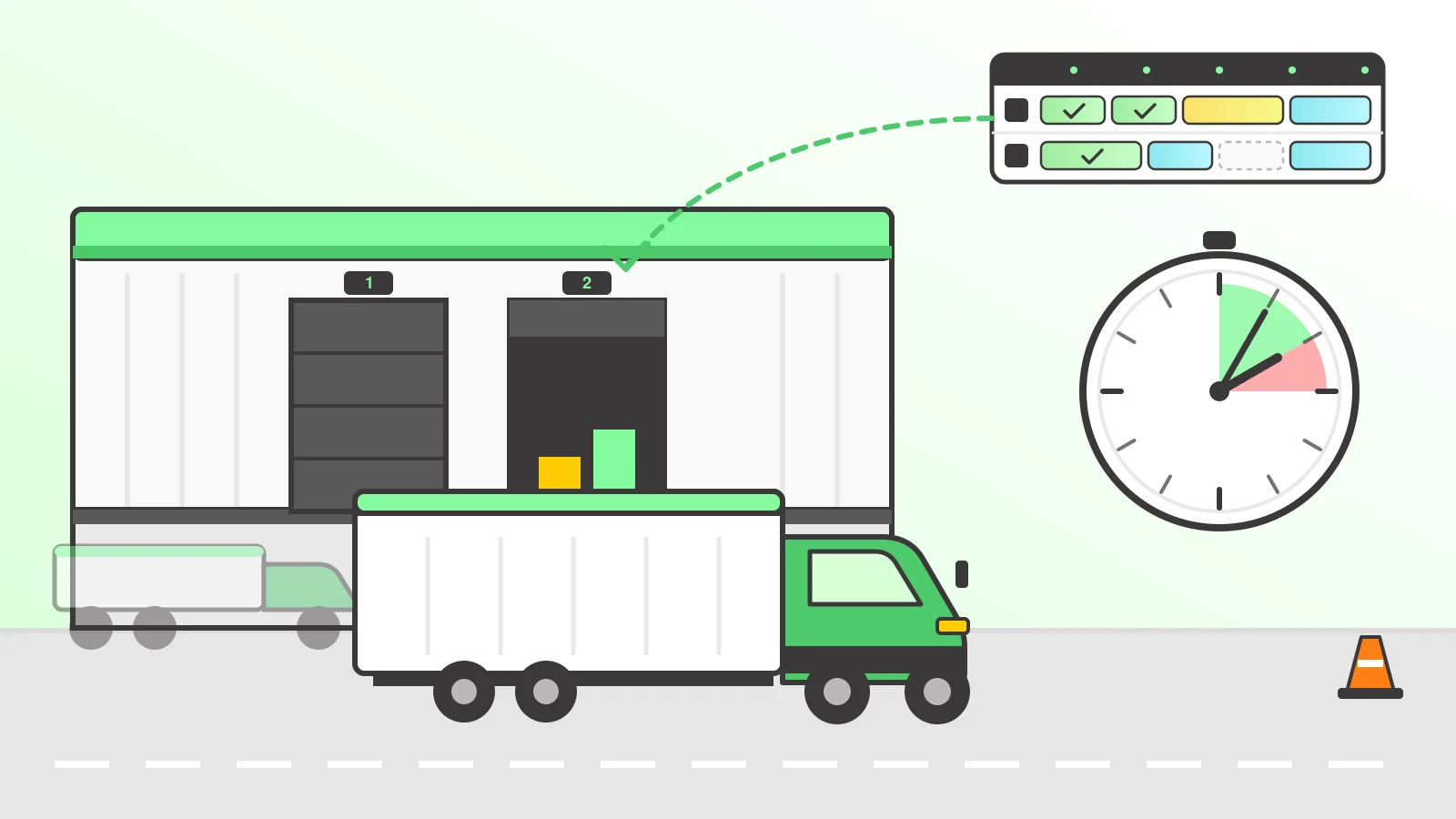
How to reduce detention fees: put every truck on an appointment, match slot lengths to real loading times, and log arrival, dock-in and departure automatically.
![How Much Does Dock Scheduling Software Cost? [2026 Pricing Comparison]](/assets/blog/dock_scheduling_software_cost-8463ea4974f5bc10aa183dee2e5f8c8139acfed8804ad040f32985c7e3080efb.webp "How Much Does Dock Scheduling Software Cost? [2026 Pricing Comparison]")
How much does dock scheduling software cost in 2026? Every vendor's price with sources — from $0.55 per booking to $15,000+ per year, compared side by side.
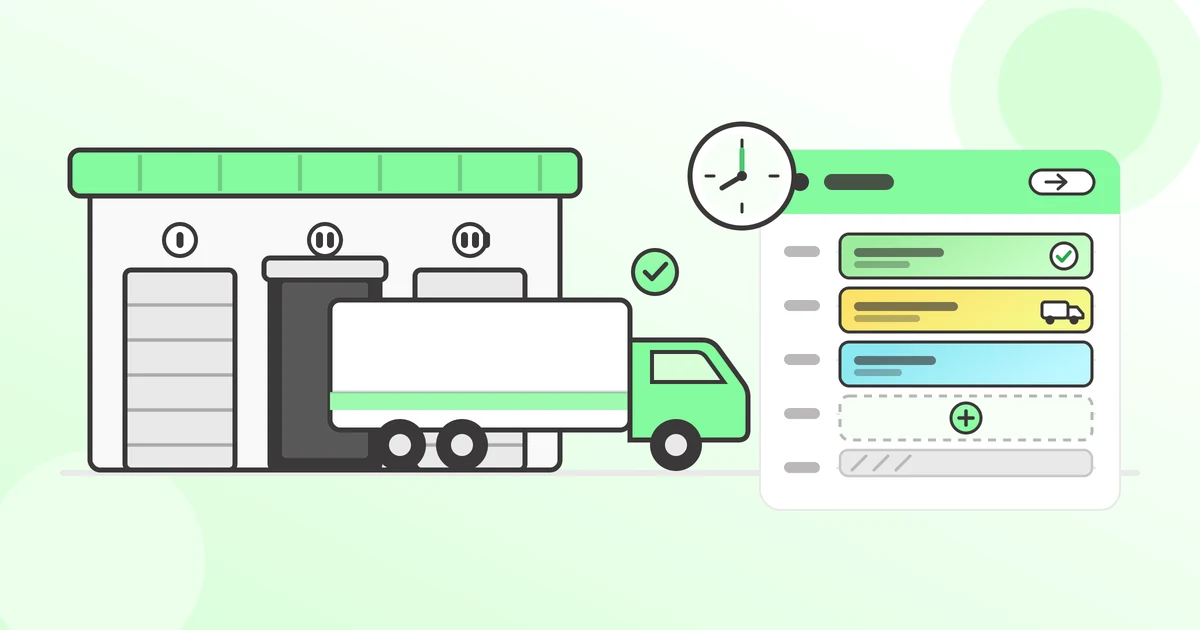
Dock scheduling assigns time slots to trucks at warehouse loading docks. Learn how the process works, what poor scheduling costs (ATRI 2024 data), and when software makes sense.
Ready for simpler warehouse scheduling?
Join warehouse teams across the world that replaced spreadsheets and phone calls with simple dock appointment scheduling software.
Start My Free Trial 14-day free trial · No credit card required · Cancel anytime